Bowfishing in Indiana: Complete Guide
March 19, 2026

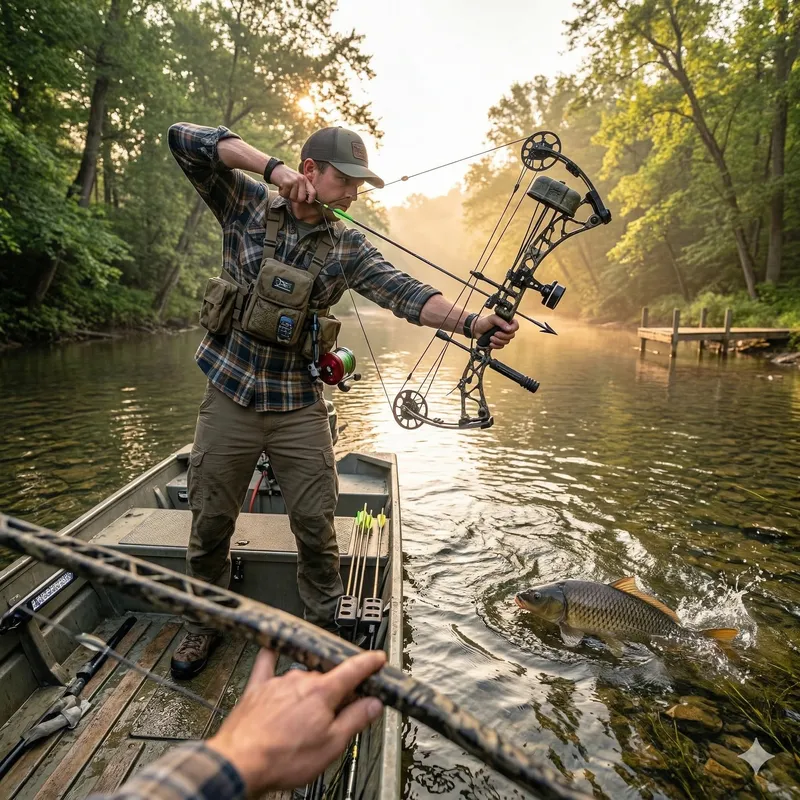
Bowfishing combines archery and fishing into one of Indiana’s fastest-growing outdoor sports. With a year-round season, abundant rough fish, and hundreds of accessible lakes and rivers, Indiana offers some of the best bowfishing in the Midwest. Whether you’re a bowhunter looking for off-season action or an angler ready to try something new, this guide covers everything you need to get started.
Indiana Bowfishing Regulations
A standard Indiana fishing license is the only license required. No archery or hunting permit is needed.
Legal Species
You may bowfish for non-game species only:
| Legal Targets | Off-Limits (Game Fish) |
|---|---|
| Common carp | Bass (all species) |
| Asian carp (silver, bighead, grass) | Walleye / sauger |
| Gar (shortnose, longnose, spotted) | Crappie |
| Buffalo fish (bigmouth, smallmouth) | Bluegill / panfish |
| Bowfin | Trout / salmon |
| Suckers (all species) | Muskie / pike |
| Shad (gizzard, threadfin) | Catfish (all species) |
Shooting a game fish is a violation — know your species identification before you shoot.
Equipment and Time Rules by Water Type
| Water Type | Legal Equipment | Legal Hours |
|---|---|---|
| Lakes, ponds, reservoirs | Bow and arrow with tethered reel only | Day and night, year-round |
| Large streams | Bow and arrow with tethered reel only | Day and night, year-round |
| Small streams | Bow and arrow with tethered reel only | Sunrise to sunset only |
Crossbows are only legal on large streams — they are prohibited on lakes, ponds, reservoirs, and small streams.
Other Rules to Know
- City ordinances: Some municipalities prohibit discharging projectile weapons within city limits. Always check local ordinances before bowfishing in urban areas
- No bag limit on most rough fish species — Indiana encourages harvest of carp and other invasive species
- Arrow must be tethered to the bow via a reel or line at all times
- Check the Indiana fishing regulations for any special regulation waters
Legal Target Species — Identification Guide
Accurate species identification is critical. Shooting a game fish carries a fine and could cost you your license.
Common Carp
The primary bowfishing target in Indiana. Golden-bronze body, large scales, barbels on each side of the mouth. Found in virtually every Indiana lake and river. Carp average 5-15 pounds but fish over 30 pounds are taken regularly.
Asian Carp (Invasive)
Three species found in Indiana’s river systems:
- Silver carp — the jumpers. Known for leaping out of the water when startled by boat motors. Silver-white body, no barbels, upturned mouth
- Bighead carp — larger (up to 60+ lbs), dark mottled head, low-set eyes
- Grass carp — elongated body, no barbels, found in lakes and rivers statewide
Indiana actively encourages harvest of all Asian carp species to protect native fisheries.
Gar
Three species in Indiana: shortnose, longnose, and spotted. All have elongated bodies with hard, diamond-shaped scales and long snouts full of teeth. Gar surface regularly to gulp air, making them visible targets in summer. Longnose gar are most common; spotted gar prefer weedy, slow-moving water.
Buffalo Fish
Use caution. Buffalo fish (bigmouth and smallmouth) resemble carp but are native species. Some buffalo fish live over 100 years, and conservation groups have raised concerns about overharvest. Key differences from carp: buffalo have no barbels, smaller mouths, and a more humped back. If you’re unsure, don’t shoot.
Bowfin
Prehistoric-looking fish with a long dorsal fin, rounded tail, and a dark spot near the tail base. Found in weedy, slow-moving water. Often mistaken for snakehead (which is not established in Indiana).
Best Bowfishing Spots in Indiana
Southern Indiana
Lake Monroe · Monroe County · 10,750 acres Indiana’s largest inland lake is a bowfishing destination, especially during the late-May carp spawn. The Crooked Creek area and shallow coves on the east side concentrate fish in knee-deep water. View lake profile →
Patoka Lake · Dubois County · 8,800 acres Excellent all-around bowfishing for carp and gar. Shallow creek arms on the upper end hold concentrations of rough fish from May through September. View lake profile →
Ohio River (Indiana bank) The entire Indiana border along the Ohio River offers bowfishing for carp, gar, and buffalo. Best near backwater sloughs and tributary mouths where rough fish congregate. Requires a substantial boat for safe navigation.
Hovey Lake · Posey County A shallow oxbow lake surrounded by cypress trees — classic bowfishing water. Carp stack up in shallow areas during spring. Limited access keeps pressure low.
Central Indiana
White River (Indianapolis south to Martinsville) The White River system holds carp, gar, buffalo, and suckers throughout central Indiana. Wade-accessible in many areas. Several fishing guides operate on this stretch.
Sugar Creek (Crawfordsville area) · Montgomery County A wade-friendly stream with good carp populations. Evening stalking along shallow riffles is productive from May through August.
Wabash River (south of Lafayette) Indiana’s longest river offers excellent bowfishing for carp, gar, and buffalo. Boat access is recommended for the best water. The stretch between Lafayette and Terre Haute has numerous launch ramps.
Northern Indiana
Lake Michigan South Shore · LaPorte County Shallow marsh areas along Indiana’s Lake Michigan shoreline offer unique stalking opportunities during the carp spawn. Best in late May and June.
St. Joseph River (South Bend area) · St. Joseph County Good carp concentrations near man-made structures and dam pools. Accessible from multiple public launch points.
LaSalle Fish & Wildlife Area · Newton County One of the best public-access bowfishing areas in northern Indiana. Backwater marshes hold carp, buffalo, and gar. Variety is hard to beat here.
Bruce Lake · Fulton County A lesser-known spot specifically recommended for gar. Shallow water and good visibility make for productive bowfishing.
When to Go — Seasonal Calendar
| Month | Rating | What’s Happening |
|---|---|---|
| January–March | Slow | Fish are deep and inactive. Legal but not productive |
| April | Fair | Water warming, carp moving shallow. Early action on warm days |
| May | Excellent | Carp spawn peaks late May — the best bowfishing of the year |
| June | Excellent | Post-spawn carp still shallow. Night fishing becomes prime |
| July | Great | Gar surface regularly. Night fishing is productive |
| August | Good | Gar fishing peaks. Evening/night trips are best |
| September | Fair | Fish begin moving deeper. Mornings and evenings still productive |
| October–December | Slow | Water cooling, fish deeper. Action limited to warm spells |
Day vs. Night
- Daytime is best during the carp spawn (May) when fish are visibly stacked in shallows. Polarized sunglasses are essential for spotting fish
- Nighttime (June–August) is when serious bowfishers do their best work. Boat-mounted lights illuminate the shallows, fish are less skittish, and boat traffic disappears after dark
Essential Bowfishing Gear
Starter Setup
| Item | Purpose | Budget Range |
|---|---|---|
| Recurve bow (30-50 lb draw) | Primary weapon — simple, reliable | $80-150 |
| Bowfishing arrows (fiberglass) | Heavy, durable, designed for water | $10-20 each |
| Drum reel or spin-cast reel | Retrieves arrow and fish | $30-60 |
| Barbed arrow tips | Prevents fish from sliding off | Included with arrows |
| Polarized sunglasses | See fish through surface glare (daytime) | $15-40 |
| Bowfishing gloves | Protect hands from line and fish | $10-20 |
Total starter budget: $150-300 — significantly less than a rod-and-reel setup for most fishing styles.
Upgrading Your Setup
- Compound bow with bowfishing cam or a dedicated bowfishing compound (AMS, Cajun, PSE) — more power, easier to hold at full draw
- Bottle reel (AMS Retriever) — the most popular reel style among experienced bowfishers. Line feeds from a bottle, reducing tangles
- Boat-mounted lights — halogen or LED light bars for night fishing. Mounted on a raised platform or the bow of a jon boat
- Elevated shooting platform — gives a better angle and reduces refraction distortion
- Fan-tail or flat-bottom boat — shallow-draft boats are ideal. Many bowfishers convert jon boats with platforms and lights
Bowfishing Techniques
The Refraction Rule
Water bends light, making fish appear higher than they actually are. Always aim below the fish. The general rule:
- Fish at 1 foot deep → aim 4 inches low
- Fish at 2 feet deep → aim 8 inches low
- Fish at 3 feet deep → aim 12 inches low
The deeper the fish and the sharper your angle, the more you need to aim low. This is the single most important skill in bowfishing — and the hardest to learn. Expect to miss often at first.
Shot Distance
Keep shots under 15 feet when possible. At 10 feet with a fish in 1-2 feet of water, you have the best combination of accuracy, penetration, and refraction management. Long shots look impressive but miss far more often.
Stalking (Wading)
Wade slowly through shin-to-knee-deep water, watching for carp tails, mud plumes, or shadows. Move upstream so disturbed sediment flows behind you. Best during carp spawn in shallow flats and flooded fields.
Boat Shooting
From an elevated platform on a slow-moving boat, scan ahead with lights (at night) or polarized glasses (daytime). The shooter stands on the platform while a partner controls the trolling motor. Approach fish slowly — carp spook from hull vibration before they see you.
Night Fishing Technique
Use boat-mounted lights angled into the water 10-15 feet ahead of the boat. Move slowly along shorelines and shallow flats. Fish are drawn to the light and are less wary at night. Keep noise to a minimum — sound carries farther over water after dark.
Indiana Bowfishing Tournaments and Events
- Cajun 8 Bowfishing Tournament — held annually at Angel Mounds State Historic Site in Evansville. One of the largest tournaments in the region with over $30,000 in prizes
- Local club tournaments — check the Bowfishing Association of America and Indiana bowfishing forums for current event listings
- Many tournaments are charity events that donate harvested fish for fertilizer or animal feed
Bowfishing Guide Services
If you want to try bowfishing without investing in gear, a guided trip is the best way to start. Guides provide all equipment, boats, and instruction.
- Broken Nock Bowfishing (Southern Indiana, White River area) — all-inclusive trips for up to 4 shooters with all equipment provided
- Check the Indiana DNR’s Licensed Fishing Guides directory for additional bowfishing guide services
- Browse Indiana fishing guides on this site for guides who offer bowfishing trips
Tips for First-Time Bowfishers
- Start with carp. They’re the most abundant target, easiest to find, and most forgiving of imperfect shots
- Go during the spawn. Late May carp spawning concentrations give you the most opportunities to practice
- Bring extra arrows. You’ll lose some — fiberglass arrows are cheap and designed to be expendable
- Book a guide first. One guided trip teaches you more than a season of trial and error. You’ll learn boat positioning, species ID, and aiming fundamentals in a few hours
- Wear old clothes. Bowfishing is messy. Carp slime, mud, and water are part of the experience
- Know your species. Study the difference between carp and buffalo, gar and pike, bowfin and bass before you go. When in doubt, don’t shoot
- Check local ordinances. Even though state law allows bowfishing, some cities and towns restrict discharge of projectile weapons within their limits
- Respect the resource. Dispose of harvested fish responsibly — never leave dead fish on the bank. Many bowfishers compost carp or use them as garden fertilizer
Frequently Asked Questions
Do I need a fishing license to bowfish in Indiana?
Yes. A standard Indiana fishing license is required for bowfishing. No additional archery or hunting license is needed — just a valid fishing license covering the water you're on.
Can I bowfish at night in Indiana?
Yes, on most waters. Night bowfishing is legal year-round on lakes, ponds, reservoirs, and large streams. The exception is small streams, where bowfishing is only allowed from sunrise to sunset.
Can I use a crossbow for bowfishing in Indiana?
Only on large streams. Crossbows are prohibited for bowfishing on lakes, ponds, reservoirs, and small streams. On all water types, a standard bow (recurve or compound) with a tethered reel is legal.
What fish can I bowfish in Indiana?
Legal bowfishing targets include common carp, Asian carp (silver, bighead, grass), gar (shortnose, longnose, spotted), buffalo fish, bowfin, suckers, and shad. Game fish like bass, walleye, crappie, and trout are strictly off-limits.
When is the best time to bowfish in Indiana?
Late May through July is prime season. Carp spawning in late May creates the best conditions, with fish stacked in shallow water. Summer nights from June through August are also excellent — less boat traffic and fish move into the shallows.