Blue Catfish Fishing in Indiana
The blue catfish holds Indiana’s all-tackle state record for the heaviest fish ever caught — a massive 104-pound specimen pulled from the Ohio River in 1999. This species represents the pinnacle of catfishing in Indiana, offering the chance at truly enormous fish on a river system that consistently produces blue cats over 50 pounds. While the blue catfish fishery in Indiana is geographically limited primarily to the Ohio River corridor, it is a growing and increasingly popular pursuit among serious catfish anglers.
Identification
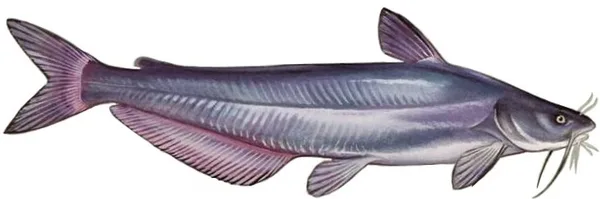
Blue catfish are the largest species in the North American catfish family. They can be distinguished from channel catfish by their straight-edged (not rounded) anal fin, which typically has 30 to 36 rays. Blue cats lack the dark spots found on younger channel catfish, and their back is a uniform blue-gray to slate color that fades to a white belly. The tail is deeply forked. Compared to flatheads, blue catfish have a more normally shaped head, a forked tail, and an upper jaw that extends beyond or is equal to the lower jaw.
Where to Find Blue Catfish
The Ohio River is Indiana’s blue catfish destination. This massive river system, forming the state’s entire southern border, provides the deep, swift-flowing habitat that blue catfish prefer. Key areas include:
Dam tailwaters are the most reliable blue catfish locations. The turbulent, oxygen-rich water below Ohio River dams concentrates baitfish, and blue cats stack up in the deeper holes and current seams below these structures. Markland Dam, McAlpine Dam (Louisville area), Cannelton Dam, Newburgh Dam, and Uniontown Dam all produce quality blue catfish.
Channel ledges and drop-offs in the main river hold blue catfish throughout the year. Fish use these depth transitions as travel corridors and feeding stations. Sonar is critical for locating the ledges and the fish holding along them.
Tributary mouths where rivers like the Wabash, Blue River, Anderson River, and smaller creeks enter the Ohio River create current seams and food-rich zones that attract blue catfish, especially after rain events.
The blue catfish population in the Ohio River has been expanding in recent decades, and there is evidence of increasing numbers in the lower Wabash River as well.
Seasonal Patterns
Spring (March-May): Blue catfish become increasingly active as water warms past 50 degrees. Pre-spawn fish move from deep winter holding areas toward shallower flats and upstream staging areas. Cut bait fished on channel edges and near tributary mouths produces well.
Summer (June-August): Blues spawn when water temperatures reach 70 to 75 degrees. Post-spawn fish feed heavily and are distributed across a range of depths. Dam tailwaters are particularly productive through summer. Both day and night fishing produce results.
Fall (September-November): One of the best periods for trophy blue catfish. Fish feed aggressively to build fat reserves for winter, and larger fish often become more active during this window. Target channel ledges, dam tailwaters, and deep holes. Fresh cut skipjack herring is at its best during fall.
Winter (December-February): Blue catfish remain catchable through winter, unlike flatheads. They congregate in deep holes and slow-current areas. Fishing is slower but persistent anglers working deep structure with cut bait still connect with quality fish.
Tactics and Rigging
Blue catfish fishing on the Ohio River is primarily a boat-based pursuit, though productive bank fishing exists below dams and at certain river access points.
Cut bait is king. Fresh-cut skipjack herring is the top bait for Ohio River blue catfish. Skipjack are an oily, strong-scented baitfish that blue cats find irresistible. Cut gizzard shad is the second choice. Cut the bait into chunks (not strips) that expose flesh and allow scent to disperse in the current. Fillet sections from larger skipjack work well for targeting bigger blue cats.
The standard bottom rig is a slip sinker setup using 3 to 8 ounces of weight (more in heavy current), a barrel swivel, 24 to 36-inch leader of 40 to 60-pound line, and a 7/0 to 10/0 circle hook. Heavy braided main line (50 to 80-pound test) is the standard for Ohio River blue cat fishing due to the heavy current and potential for very large fish.
Anchor fishing is the most common boat approach — anchoring above a known hole, ledge, or tailwater and presenting baits downstream. Drifting cut bait along channel ledges with controlled drift speed is also effective for covering water and locating fish.
Rod and reel setups should be heavy-duty. Seven to eight-foot heavy-action rods with large conventional or baitcasting reels handle the demands of big blue catfish in heavy current. Carry a quality landing net or lip grip and plan for how you will handle a fish that could exceed 50 pounds.