Flathead Catfish Fishing in Indiana
The flathead catfish is Indiana’s premier trophy catfish species and one of the largest freshwater fish an angler can catch in the state. The current Indiana record — 79 pounds 8 ounces from the White River, caught in 1966 — hints at the enormous potential these fish offer. Flatheads exceeding 40 and 50 pounds are caught each year from Indiana’s major river systems, and fish in the 20 to 30-pound class are not uncommon for dedicated catfish anglers.
Identification
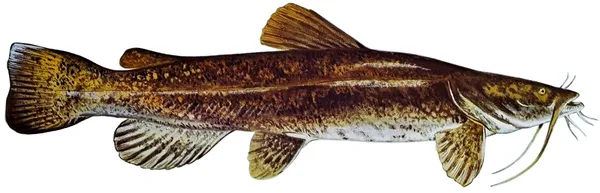
Flathead catfish are unmistakable. They have a broad, flattened head with a protruding lower jaw (the lower jaw extends beyond the upper, unlike channel and blue catfish). Their coloration is mottled yellow-brown to olive, earning them the common nickname “yellow cat.” The tail is only slightly notched, not deeply forked like a channel catfish. The anal fin is short and rounded with fewer than 16 rays. Flatheads can be distinguished from all other Indiana catfish by their squared-off tail and distinctive flat head profile.
Where to Find Flathead Catfish
Flatheads are primarily a river species in Indiana. The Wabash River from Huntington downstream to its confluence with the Ohio River holds excellent flathead populations throughout its length. The White River (both the main stem and the West Fork), East Fork White River, Tippecanoe River, and the Ohio River along Indiana’s southern border are all top-tier flathead fisheries.
Within these rivers, flatheads relate to heavy cover and deep structure. They hold in and around submerged log jams, under undercut clay banks, in deep scour holes below dams, and around bridge pilings. During the day, flatheads hunker down in these lairs. After dark, they move to adjacent flats, riffles, and shallower feeding areas to hunt.
Some Indiana reservoirs also support flathead populations, including Patoka Lake and Monroe Lake, though rivers consistently produce larger fish.
Seasonal Patterns
Spring (April-May): Flatheads become active as water temperatures rise above 55 degrees. They begin moving from deep winter holes to shallower staging areas near spawning habitat. Fishing can be inconsistent but produces some large pre-spawn fish.
Summer (June-September): This is prime flathead season. Spawning occurs in June when water temperatures reach 70 to 80 degrees. Flatheads spawn in cavities — hollow logs, undercut banks, and rock crevices. Post-spawn flatheads feed aggressively through the summer, and this period produces the most consistent action and the largest fish. Night fishing from late June through September is the most productive approach.
Fall (October-November): Flatheads feed heavily before winter but become more unpredictable. Focus on deep holes and slower-moving water. Live bait fished tight to structure remains the key.
Winter (December-March): Flatheads are largely dormant in winter, stacking up in the deepest river holes. Occasional fish can be caught on warm-up days, but most anglers wait for spring.
Tactics and Rigging
Flathead fishing in Indiana is built around one principle: live bait, fished on the bottom, near heavy cover, after dark.
The standard rig is a heavy-duty slip sinker setup. Use a 3 to 8 ounce no-roll or bank sinker (depending on current), threaded above a heavy-duty barrel swivel, with a 24 to 36-inch leader of 50 to 80-pound monofilament or braided line to a 5/0 to 8/0 circle hook. Hook live bluegill or green sunfish through the back (dorsal fin area) to keep them lively and struggling.
Gear should be substantial. A 7 to 8-foot heavy-action rod paired with a large baitcasting reel (Abu Garcia 6500 or 7000 class is standard) spooled with 50 to 65-pound braided line gives you the backbone to pull big flatheads away from snags. Set your rod in a sturdy holder and keep the reel in free spool with the clicker engaged.
Position baits along the edges of log jams, at the mouths of deep holes, along current seams where fast and slow water meet, and near the bases of outside river bends. Set multiple rods to cover different zones within a single area. When a flathead picks up your bait, let it move off before engaging the reel — circle hooks will do the rest.
River access points along the Wabash and White River provide ample bank fishing opportunities. Many anglers also use jon boats or kayaks to reach remote river stretches where pressure is low and flathead numbers are high.