Longnose Gar Fishing in Indiana
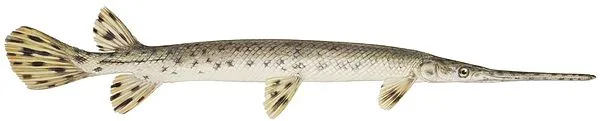
The longnose gar is a prehistoric survivor that has inhabited North American waters for over 100 million years. In Indiana, the longnose gar is the most common and widespread of the state’s gar species, found throughout major river systems and their associated backwaters. With their elongated, torpedo-shaped bodies and bony snouts lined with needle-sharp teeth, longnose gar are unmistakable. The Indiana state record is a 23-pound, 12-ounce fish taken from the Ohio River in Floyd County in 2025.
Identification
Longnose gar are easily identified by their extremely long, narrow snout — the distance from the eye to the tip of the snout is more than twice the width of the head. Adults are olive to dark green on the back with a white belly. The body is covered in hard, diamond-shaped ganoid scales that function as a suit of armor. Most Indiana longnose gar range from 24 to 36 inches, though fish exceeding 40 inches are regularly encountered in the Wabash and Ohio River systems.
Where to Find Longnose Gar
Longnose gar favor slow-moving rivers, backwater pools, oxbow lakes, and the sluggish stretches of larger streams. In Indiana, the Wabash River from Lafayette downstream to its confluence with the Ohio River is the premier gar fishery. The White River through Indianapolis and downstream, the East Fork White River, and the Tippecanoe River all support healthy populations. The Ohio River and its tributaries along Indiana’s southern border hold both longnose and shortnose gar.
Look for gar near the surface in calm water, especially during warm weather. They are obligate air breathers and must periodically roll at the surface to gulp air, making them easy to spot. Backwater areas, oxbow lakes, slack pools below dams, and the mouths of tributary creeks are consistent holding spots.
Rod-and-Reel Tactics
Hooking a longnose gar on conventional tackle is a challenge because their bony, elongated jaws make traditional hook sets difficult. The most reliable method is the rope lure. Take a 4 to 6-inch length of braided nylon rope, unravel it into hundreds of fine fibers, and attach it to a jig head or wire leader. When a gar strikes, the fibers tangle in its teeth, holding the fish without requiring a hook. Retrieve the rope lure slowly near the surface where gar are cruising.
For bait fishing, rig a piece of cut shad, skipjack herring, or a live minnow under a large slip float and position it near surfacing gar. When the gar takes the bait, do not set the hook immediately. Gar grab prey crosswise and hold it for several minutes before turning and swallowing it headfirst. Wait until the float moves steadily away before setting the hook with a firm sweep.
Use a medium-heavy rod with 20 to 30-pound braided line and a short wire or heavy fluorocarbon leader to handle the gar’s abrasive teeth and thrashing.
Bowfishing for Gar
Longnose gar are among the most popular bowfishing targets in Indiana after carp. Their habit of basking near the surface in shallow water makes them ideal for the bowfishing approach. Concentrate on backwater areas, river sloughs, and shallow flats where gar congregate, particularly from May through August.
Aim slightly below the fish to compensate for light refraction in the water. Gar scales are extremely hard, so a sharp broadhead and a bow with sufficient draw weight (at least 40 pounds) are necessary to achieve penetration. Many bowfishers target gar from boats drifting slowly through backwater channels, though wading in knee-deep water can also be productive.
Seasonal Patterns
Spring (May-June): Gar spawn in shallow, weedy backwaters when water temperatures reach 65 to 70 degrees. Spawning aggregations of multiple fish are common and provide excellent bowfishing opportunities. Rod-and-reel anglers can sight-cast rope lures to visible fish.
Summer (June-August): Peak season. Gar are most active and visible during warm weather, surfacing frequently to breathe. Morning and evening periods produce the best surface activity.
Fall (September-October): Gar remain active but begin moving toward deeper wintering holes as temperatures drop. Surface activity decreases but bait fishing in deeper pools remains productive.
Winter (November-March): Gar become largely inactive and congregate in deep river holes. They are rarely targeted during this period.