
Overview
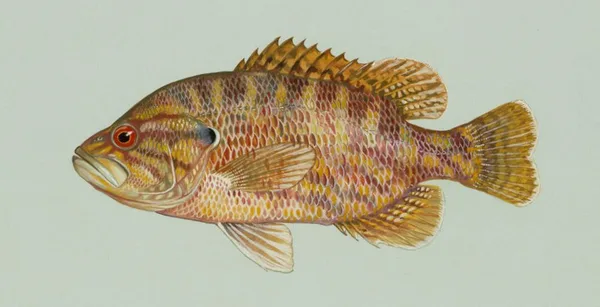
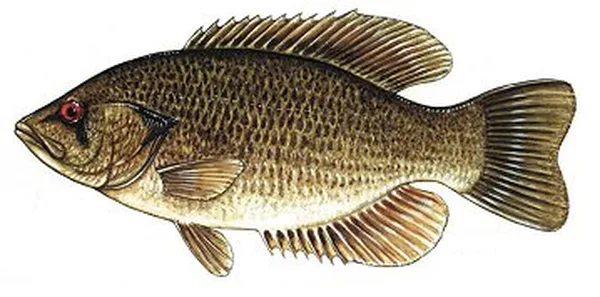
The rock bass is a staple of Indiana’s clear stream fisheries. Known locally as “redeye” or “goggle-eye” for their large, bright red eyes, rock bass are one of the most aggressive and cooperative fish in the state. They hit hard relative to their size, feed throughout the day, and are found in many of the same scenic streams that attract smallmouth bass anglers. For anyone wading Indiana’s rocky creeks with light tackle, rock bass are a constant and welcome companion.
Rock bass are built heavier than typical sunfish, with a large mouth, thick body, and an olive to bronze coloring marked with dark blotches arranged in rows along the sides. Their large red eyes are the most reliable identification feature. They can change color rapidly, darkening or lightening to match their surroundings — a trait that sometimes startles anglers unfamiliar with the species.
Where to Find Them in Indiana
Indiana’s best rock bass water runs through the central and western parts of the state where clear, rocky streams cut through limestone and sandstone terrain. Sugar Creek, flowing through the covered bridge country of Parke and Montgomery counties, is one of the top rock bass destinations in the Midwest. The riffles and pools between Crawfordsville and Turkey Run State Park produce excellent fishing from May through September.
The Blue River in southern Indiana is another premier rock bass stream, particularly the section from Fredericksburg downstream through Harrison County. Wildcat Creek in Carroll County, Big Pine Creek in Warren County, and the Tippecanoe River from its headwaters in Kosciusko County downstream through Fulton and White counties all hold strong populations.
In southern Indiana, tributaries of the East Fork of the White River and the Muscatatuck River system support rock bass in their cleaner, rockier reaches. Clifty Creek near Madison and Laughery Creek in Dearborn County are worth exploring.
Rock bass hold in pools below riffles, along rocky ledges, near submerged boulders, and in the shade of overhanging trees. They prefer moderate current over clean rock and gravel substrate.
Techniques
Wade fishing with ultralight or light spinning tackle is the classic approach. A 5- to 6-foot ultralight rod with 4- to 6-pound line handles rock bass well while still providing sport. The go-to setup is a 1/16-ounce jig head with a 2-inch tube or small soft plastic crawfish, cast upstream and worked back through pools and along rock structure.
Small inline spinners in sizes 0 through 2 — Roostertails, Panther Martins, and similar patterns in gold or brown — are reliable search baits for covering water. Retrieve them across current seams and along rocky banks.
For live bait, a small crayfish on a size 6 hook drifted through pools is deadly. Worms, crickets, and hellgrammites all produce, fished on the bottom or under a small float. Minnows work well in deeper pools and tailwater areas.
Fly anglers will find rock bass eager targets. Woolly buggers in sizes 6 through 10, small crawfish patterns, and poppers all draw aggressive strikes. A 4- or 5-weight rod is well-matched to rock bass in moving water.
Tips
Rock bass feed aggressively through a long season. While spawning activity peaks in late May and June, they remain active and catchable from early May through late September. They feed throughout the day, unlike many panfish that slow down during midday, making them a reliable option for all-day stream trips.
Rock bass are often found holding near smallmouth bass. If you are catching rock bass consistently, there are likely smallmouth in the same stretch. Many Indiana stream anglers use rock bass activity as an indicator of overall stream health and smallmouth presence.
One key to catching larger rock bass is to focus on deeper pools with substantial rock structure. The biggest fish in a stream reach typically hold in the deepest available pool, often near the largest boulder or ledge. Work your bait slowly along the bottom in these areas rather than fishing the shallows.
During summer, early morning wading sessions before recreational canoe traffic picks up tend to produce the best fishing on popular streams like Sugar Creek and the Blue River. Rock bass will retreat to deeper cover when heavy boat traffic disturbs the water.